
Alterkin Revisited
An alternative kinship circle for those aging without children

In May 2025, a group of eight people aging without children met in my living room in rural Ireland to discuss forming a community of care—an ‘Alterkin Circle’.
Since then, around six of us have met once or twice a month, and our modest experiment has attracted a lot of attention, including, amazingly, a write-up in The Atlantic magazine, thanks to an interview with Stephanie H. Murray.

I wrote about the need for our Alterkin Circle, and the steps it took to bring it into being on my Substack here in July 2025.
Alterkin Year 1 - how we’ve developed
During our first six months of monthly Sunday coffee mornings in each other’s homes, we refined a document which we now affectionately refer to as ‘The V&P doc’ (‘Visions and Principles’). It wasn’t the only thing we did during that time, but we did revisit it each month, until it got to a point where we were each happy to sign it.
We now open our Circles by passing our V&P document around the room, taking turns to each read a point aloud. Doing so reminds us of the behaviours we’ve committed to, and the vow we have taken to each other. It also reminds us that although Alterkin is beginning to feel like a gathering of friends, it is nourished by something more intentional.
Below is our V&P document, which you are welcome to download if it might help inform your own community of care structure.
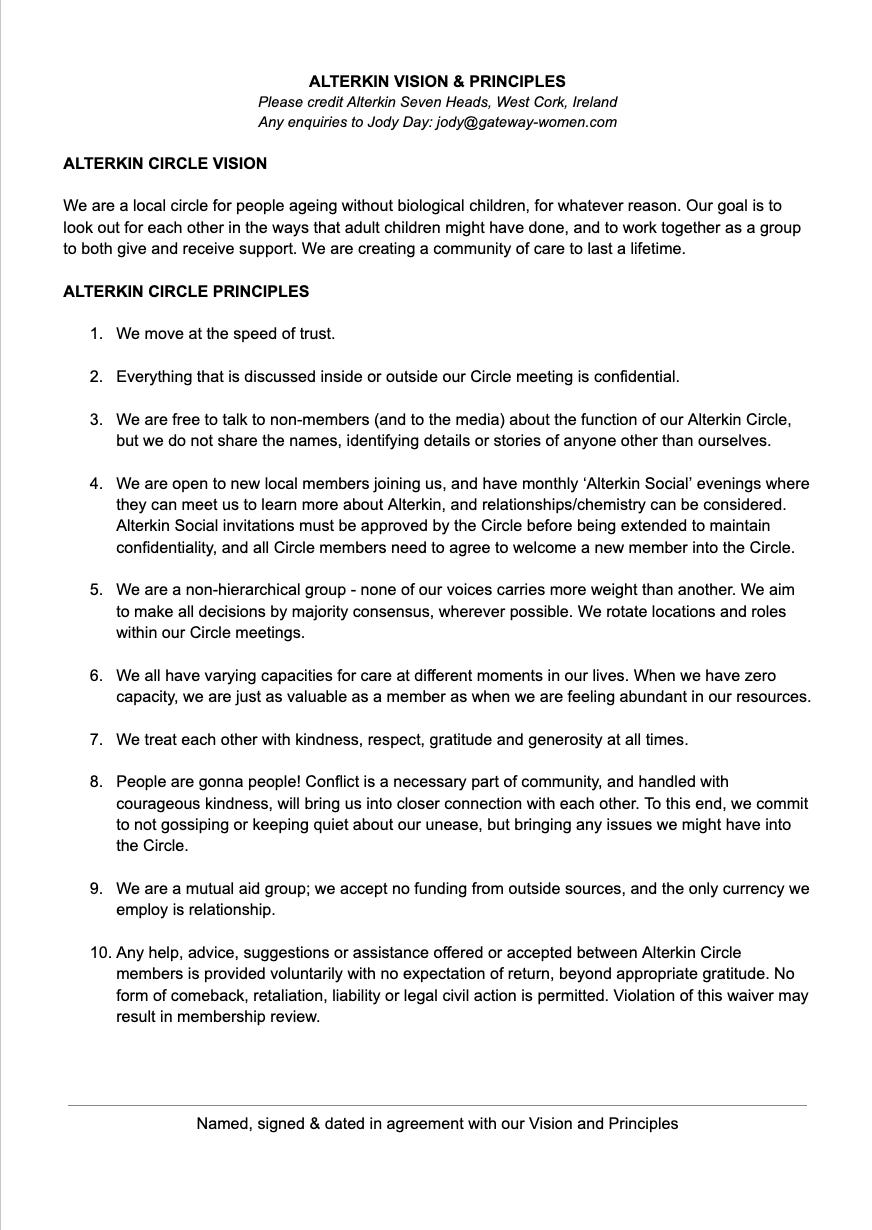
What our V&P document (and the discussions that went into it) has attempted to capture are some of the hopes and fears that naturally arise when people choose to come together.
Because, as we say in Principle 8: ‘people are gonna people’!
It seems that deep down, we all carry concerns into a new group: fears around vulnerability—around being neglected, used, misunderstood, rejected, bullied, unseen and abandoned. Because we all carry relational wounds of how things may have gone wrong in other settings, including that very first group, the family we grew up in.
The fear of vulnerability
When I surveyed the members of the Childless Elderwomen subgroup of 200 women, aged 50+, within the Childless Collective online membership community, fears around other people’s behaviours surfaced repeatedly as the main reason for not starting an Alterkin Circle, or something similar. The other one was ‘not yet living in the place I think I’ll be aging,’ which sounds rational—yet what if developing our capacity to build these kinds of relationships is never wasted, even if we do later move? And maybe this points to how the transactional nature of capitalism has invaded even our most private domains.
Here are some of the fears and concerns that come up:
I don’t know who to ask to join, and I don’t know how to find them, and I don’t know what to say if I did find them. What if they say no? And if they say yes, what then?
How can I reveal that I don’t have support as I age because I don’t have children without creating (more) opportunities for people to pity or judge me?
I live in a big city, and everyone is too spread out to create a group like this; I live in a very rural location, and everyone is too spread out to create a group like this.
I’m already stretched thin as a caregiver and/or a wage-earner; I can’t do this too.
What if I get taken advantage of logistically or financially by others?
I value my privacy, and I hate asking for help; my life circumstances have forced me to become completely self-reliant, and I’m not sure how to change that, or if I want to.
What if cliques form within the group and, once again, I don’t feel included or welcome? What if I am ‘othered’ by couples as someone ageing without a partner?; What if my partner doesn’t want to be a part of this?
I find making new friends challenging. What if someone I find difficult is part of the group? What if I get stuck with a group I don’t want to be a part of?
I’m an introvert, and groups are too hard for me; I’m an extrovert, and I’m tired of ending up leading whilst others sit back.
What if I end up doing all the supporting whilst my own needs get overlooked or neglected?
What if I’m seen as ‘too needy’ by others? Due to my disability/chronic illness, I don’t have anything to offer to others, so why would they be interested?
What if…
I recognise these fears.
Even though I’ve been part of the conversation around aging without children for 14 years as one of the four original campaigners that came together to form the UK Charity Ageing Without Children; even though I have been hosting my free Fireside Wisdom with Childless Elderwomen webinars for 6 years, and writing this Substack Gateway Elderwomen for 5 years… when it came to the idea of broaching the topic of creating Alterkin in the very rural Irish location where I’d only lived for two yars, I felt the fear!
And so in the two years running up to those asks, I spoke with two US-based pioneers: CAF (Community as Family) founder Wendl Kornfield in New York, and Linda J Camp, founder of The Backup Plan for Solo Agers in Minnesota (both of whose projects I plan to write about soon). I also spent six months as part of an Action Learning Group led by Emily Kenway, the author of Who Cares: the Hidden Crisis of Caregiving and How We Solve It.
Whilst the Alterkin model owes a debt of gratitude to both CAF and The Backup Plan, it has its own flavour, suited to our rural location, and both personal and cultural circumstances.
In addition, I just want to take a moment to give a shout-out to the continuing work of AWOC in the UK with its local in-person public groups, and to highlight the work of Ailene Gerhardt in developing the online Navigating Solo Network in the US.
Also, during those two years of thinking and preparation, I was in a season of deaths which profoundly shaped my sensibility: my own and my partner’s mothers died; I was a therapist to two with two solo, childless women c , childless therapy clients as they prepared for their own deaths from cancer; we lost, mourned and memorialised two beloved members of our online community, also lost to cancer—and on top of that there were the deaths of cousins and younger friends in their fifties, as well as our darling dog Parsnip.
And in all of these scenarios, it could not have been made clearer to me how differently illness, death and bereavement were experienced by, and handled for, those with and without children, and for those with and without life-partners.
Additionally, for the last year and a half, I have been dealing with Long Covid (which I’ve written about here), and have been very unwell, and many aspects of my life, work and personality have had to be let go of—parts that felt deeply important to my identity. Perhaps the most difficult symptom of my illness, on top of my own personal energy crisis, has been the decline in my cognitive and intellectual capacity, which has made writing and speech production challenging. This led to an iffy brain scan and five months of testing for some really scary life-limiting possibilities, all of which were finally ruled out a couple of weeks ago. But facing the possibility that I might need round-the-clock care in the not-too-distant future has been profoundly soul-shaping.
Although my motivation for creating our Alterkin Circle grew from my own fears about aging without children, it seems that somewhere I still imagined that I would be the one supporting others, rather than needing support. Like death, it seems I couldn’t really imagine it happening to me. My Long Covid (which thankfully does seem to be easing somewhat) has forced me to face my own ageism and ableism, and to see how strongly defended I was against the idea that I might be the one needing care one day.
Yet care is the foundation of being human: I have been cared for, I have cared, I will care, I will need care. This is what it is to be human, not a machine.
Although what we are doing with our Alterkin Circle project is nothing new (particularly for those from the LGBTQIA+ communities), I sense that it might seem radical because, as Rachel @ This Woman Votes writes in her 2025 essay Care Economies as Infrastructure: The Operating System of Civilization:
“The twentieth century ran an experiment: can civilization sustain itself while systematically devaluing care? The answer is increasingly clear: No. Climate catastrophe, mental health crises, social fragmentation, political polarization, institutional collapse, these are not separate problems but symptoms of the same disease: care deficit.”
(Rachel, This Woman Votes)
Alterkin Year 2 - what’s next
All of us in our Alterkin Circle would like to see our numbers expand but, as per Principle 1: ‘we move at the speed of trust’1, this is a necessarily slow process. We do have two members who will hopefully be rejoining us soon, having stepped back after the first couple of meetings due to logistical factors. And I’m gradually cultivating a couple of new local acquaintances to the point where it might be possible to raise the topic. Each of us is on the lookout for people we might wish to consider asking, if the Circle agrees.
Right now, our Alterkin Circle is about the size of a nuclear family, and to provide a good chance of us being there for each other if more than one of us has a season of need, we probably need to be about twice that.
However, living in a very rural area, not only are we surrounded by couples, parents and grandparents (cities tend to have more solos and non-parents)2, there are also pre-existing relationships to be considered. Despite how very friendly Ireland is, it’s also intensely private, with only family being seen as trustworthy. And despite being genetically half-Irish myself, my education, accent and culture is that of the English coloniser; so there’s that. I will forever be a ‘blow-in’ here.
“I hope we continue to get closer and closer to one another. We have an amazing group of wonderful people. I hope it continues to grow.” (Alterkin Circle Member).
For our programmed Alterkin Social events, which take place each month between our Circle sessions, we’ve had a BBQ together over a long Bank Holiday weekend, have had a winter ‘movie night’ where we voted on what film to watch, have attended music concerts together, and soon be attending a theatrical performance that one of us is taking part in. Over the summer we hope to have a day out at a beautiful natural swimming lake and to a market in a nearish town. Sometimes it’s just as simple as meeting for a drink in our local village pub. It takes work to get these in the diaries as we are not yet integral to each other’s lives—but we make the effort as we want to be.
Every opportunity we have to spend time together informally is another chance for us to get to know each other’s quirks; our hope is that this will pay dividends when the shit hits the fan in life, as it invariably does.
Amongst the Circle, social connections and support are naturally starting to take place outside the formal structure of the Circle, and there is a hunger for these to continue to grow organically. In this vein, members have given each other lifts to the airport, have helped each other find local tradepersons, have collected medicines from the pharmacy for each other when ill, have helped with choosing a new second-hand car, have been sea-swimming together, have helped each other with gardening projects, and with end-of-life paperwork. And soon we’ll all be coming together to help
declutter a garage.
In the near future, we will have the first of our ‘life story’ sessions where one member shares about their life, in whatever way they wish (and only if they wish), followed by a pot-luck Sunday brunch. This feels like a fascinating way to really deepen our knowledge of each other’s lives and histories; I know from my time at AWOC that a very common fear of those aging without children is ‘who will know me when I’m old’ (and the hidden fear within that, ‘who will speak for me, if I can’t’).
I hope this gives some idea of how we’re organically feeling our way, experimenting with both formal and informal structures, and allowing space for different personalities and styles of relating to breathe.
“As an introvert, I’m comfortable in my own company, and I’ve been surprised at the value the group has given me, both in the form of a sense of security, but also in relationships that I wouldn’t have otherwise.” (Alterkin Circle Member)
Knowing that everything we discuss is confidential within the Circle has been a powerful commitment, and is allowing for genuine intimacy to form.
“It’s good to be able to talk and listen to people in a small group, knowing that it’s not going to be gossiped around anywhere.” (Alterkin Circle Member).
So far, none of us has had a major crisis or has needed significant support, but when that happens (and it will), our hope is that we will come together as a group with a lot of soft knowledge about each other to help make our responses both effective and sustainable.
We will have the comfort of being known.
“Four words come to me when I think about our Circle: reassurance, confidence, gratitude, friendship.” (Alterkin Circle Member)
Although in some ways, Alterkin can be seen as a project purely motivated by self-interest, it cannot be done alone, and the impact on ourselves and each other, and in other areas of our lives, cannot be underestimated. As Steffi Bednarek writes in her essay The Ecology of Care:
Care does not exist in isolation. It arises between people, moves through networks, stimulates reciprocal behaviour, and creates feedback loops that strengthen the social fabric. One person acting from an instinct of care, creates consequences that extend far beyond the moment. When one person gives care, others often respond with increased generosity or trust. Neuroscience shows that witnessing care activates the brain’s social engagement system. Care grows through small interactions, not through one central agent. It expands by accumulation and interconnection, not by instruction. What we do matters.
Hopefully, one of the many beautiful benefits of our Alterkin Circle will be that as the investment of time, energy and care we’re making in each other builds, none of us will have to wait for a crisis to find out who our friends really are—we’ll have our Kinnies.
Thank you for being one of my readers; I appreciate you very much! If you’d like to support my work, you can do so by:
‘Hearting’ this post so that my heart knows that it has touched yours;
Leaving a comment (I do my best to respond to each of them);
‘Restacking’ this post using the symbol at the bottom of the post that looks like two arrowed circles
Taking out a modestly priced monthly or annual subscription in your local currency (and if you subscribe at ‘Founder’ level, I will say thank you by offering a confidential 1-hour zoom/phone chat).
Leaving me a one-off tip by buying me a coffee.
Hi Jody, firstly, I'm so glad to hear that more sinister concerns from the brain scans have now been ruled out. Your V&P document is absolutely superb. It says what so many codes of conduct fail to. It's definitely giving me food for thought. Thanks for sharing and continually inspiring.
Thanks to you and the Alterkin Group for sharing these details with us, Jody. The V&P document is beautiful in its simplicity. I don't underestimate the depth and range of discussions that it's taken to achieve this together. Congratulations.
As always, I'll be saving the links you've shared. There's so much food for thought. I'll be pondering and digging in, thanks, Big Sis!